Monday, 26 April 2010

Study leave

I was recently looking through job ads and applied to two gallery shops, both of which have yet to respond.. BUT I did also come across photographer Dominic Harris recruiting people for his project, Standing Very Still. So I enrolled! and spent one Sunday afternoon running back and forth the Oxford Circus crossing with a group of very random individuals. Here's two of my favourite shots out of about ten attempts from the day:


Trust me, I am in there somewhere. There's also a video showing us frantically run into position each time the tiny traffic light man turned green. So there.

This was naturally not enough to satisfy my art hunger (eh?) since finishing my course early, so last Friday evening, 23 April, I spent in the company of some thirty Lithuanian artists at our Baker Street-based embassy. Most of the content of the meeting is top secret of course, but I can say that I was most ecstatic to be there and more importantly - there's an exhibition coming up on 11-23 May at St Martin-in-the-Fields! More information here, scroll down to "Urban Clones". Unfortunately more detailed texts are all in Lithuanian, but the essential idea is to find emotional links between the cities of London and Vilnius, Lithuania's capital, through the means of photography. The curator of the exhibition is a third-year Lithuanian student at the Courtauld! So if you're in the area during the two weeks of its showing, do have a look.

Sunday, 4 April 2010

Victoria & Albert

Some fascinating exhibits I came across when rediscovering the V&A: the Japanese armour below, a gigantic plastic cast of the 33m Trajan's Column in Rome (photography doesn't do it justice) and Alexander McQueen's dress that Salma Hayek wore to the Vanity Fair Oscar after-party! I highly recommend visiting the gem that is this museum.

House-sitting in Notting Hill on the Easter weekend. *Bliss*

Friday, 29 January 2010

Binoculars

Tried to spot some life on Mars today and all I got was a scarcely larger orange dot.

In other news, Nick Gentry is bringing life back into floppy discs.


I'd have it on my wall.

Monday, 25 January 2010

It's been two weeks

I didn't notice how I've become fond of ceramic art. I tended to underestimate its possibilities, but by now at least two of my recent posts include clay or porcelain pieces. And here I go again - plastic surgery on dishes by Beccy Ridsdel. What a concept!


I'm happy to be back for a while after busy exam times and presentation writing, which took up my entire weekend. Although there's tonnes still to be done, I thought I'd earned a blog post or two.

I'm starting to put together one of my last final pieces for the IB course that finishes in mid-March. The base will be a large silk cloth with three heads batiked - a young face, an old one and a skull - on which will go a printed collage of.. what, I don't exactly know yet. The main theme is Shakespeare and I'm personally illustrating death and passage of time (blahh). If it turns out to be any good, I'll upload a photo. Otherwise my next project in pending is collage on pottery (inspired by Grayson Perry, of course). Now only to get this all done and, I almost forgot, visit Florence in February half term! Life is becoming good again.

I rewatched Perfume: the Story of a Murderer last night. As disturbing as it may be, it's one of the most artistic films I've ever seen. Couldn't say anything about the book, but I'm intrigued - is it as visual? The director (also of Run, Lola, Run!) did an incredible job at illustrating Grenouille's extraordinary sense of smell.

Monday, 11 January 2010

It's the light

No time to write. Exams.


Wednesday, 6 January 2010

Recently on TV

There has lately been so much on for the sake of art that I couldn't resist noting ideas down. Below are some discoveries I've made as a result.

During Where is Modern Art Now?, Dr Gus Casely-Hayford introduced the artist Grayson Perry as "everyone's favourite transvestite potter". After such a comment I surely had to had to check his work out, and I must say, I'm now quite a fan. He uses more than one technique to transfer the often brutal imagery onto surfaces, immitating collage. On clay!


so far my favourite, Hot Afternoon in 75, 1999

In Ugly Beauty, Waldemar Januszczak mentioned the British sculptor Rachel Whiteread, who apparently is the first woman to have won the Turner Prize back in 1993.

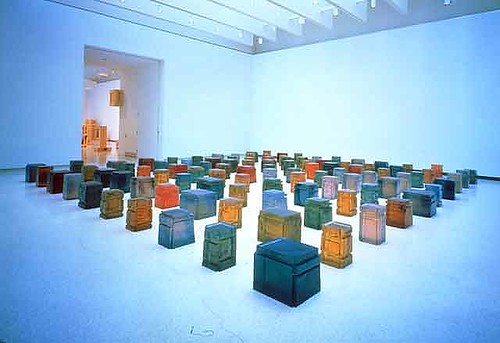
I've long considered the idea of negative space intriguing. For instance, imagine that it's never you moving, but the space around you moving you.. Well, most of Rachel's work focuses on exploring negative space. Take Untitled (One Hundred Spaces), 1997, below, which is a collection of resin casts of the empty space underneath one hundred chairs!


In a more recent project she made casts of packaging objects. In his review (worth reading for more about Rachel), David Row recalls:
"When I saw Whiteread's exhibit, it was still being unpacked, so there were actual packing materials beside Whiteread's sculptures of packing materials. Talk about life imitating art."


So let the Stuckists stick to their figures, but I think this is all brilliant. Towards the end of Ugly Beauty, Waldemar Januszczak concluded with the following idea about conceptual art:

"In an over-explained world, what could be more precious than the inexplicable?"

Tuesday, 5 January 2010

Conceptual Art

I discovered today the existence of the Stuckist movement, which, as amusing as the name may sound, has been producing figurative work in opposition to the currently dominating conceptual art. I myself have finally come to appreciate the latter, as long as the idea conveyed in the work manages to captivate me.

You have to admit that the art of today is less and less about the skill of the work and predominantly about the idea behind it - illustrating a different attitude towards an object; experimenting with an environment; shocking the public (although the last is probably no more, since we're becoming immune to provocative and daring works).
Contemporary exhibitions are dominated by installations and performance art that will illustrate our society to future generations just as, well, Baroque art illustrates 17th century society to us.

Below are a few of my favourite pieces that the Stuckists would probably disaprove of:


Curtain by Daniel Arsham

Tee trinken by Lei Xue


Believe it or not, I find these to be just as deserving of the label 'art' as a painting by Rembrandt.

Artists by Artists

I've thought of putting together a collection of portraits of artists depicted by other artists. Works like that have always interested me particularly, for they illustrate connections and relationships you never thought existed between individual names.

Did you know for instance that there was a close group of Impressionists living and working side by side in Paris, but that Edgar Degas was never a part of them due to quarrels? I find such trivia fascinating and it's time I started recording it.

First is old friend Van Gogh drawn by my beloved Henri de Toulouse-Lautrec in 1887:


Observing a work like this I begin imagining how the sitting for the portrait may have taken place. The idea alone that two such talents were in the same room together excites me. There is surely a story behind it. Oh how I'd like to know every such story.

Saturday, 5 December 2009

Pilot

I journeyed today to Portobello market to find a ring for my eighteenth. It's now on my finger as I'm typing, an original 19th century golden Italian cameo. Deliberately special so, for I can 'pass it on to my children', something that seemed very much on my mum's mind when she initially suggested buying one.

I decided to find out about the history of cameo - the miniature sculptural reliefs - as I wasn't at all familiar with it. I came across some interesting findings and will try to get back to this later to share them.

What sparked the start to this blog - although I've been accummulating material for a while now - happened on this very day and may at first seem an insignificant matter. I came across a stall displaying cheap scarves, and one with Klimt's Kiss caught my eye - the masterpiece was printed on a £3 scarf.

It attracted my eye at first, but I quickly seized to admire it, for it made me think of how much works of art are nowadays being exploited for people's financial benefit. I suppose you could argue that reproduction like this makes art more accessible, but there is no doubt that the value and meaning is getting lost along the way. When will we get to the point where museums and galleries are no longer needed to celebrate the valuable illustrations of history? Or will this on the contrary make a viewing of the original more significant?